Having largely dismantled Naxalite strongholds in Bastar, security forces have shifted their focus to a massive clearance operation.
Code-named “Operation Khazana” (Operation Treasure), the initiative aims to locate hidden stockpiles of explosives and the insurgents’ buried financial reserves.
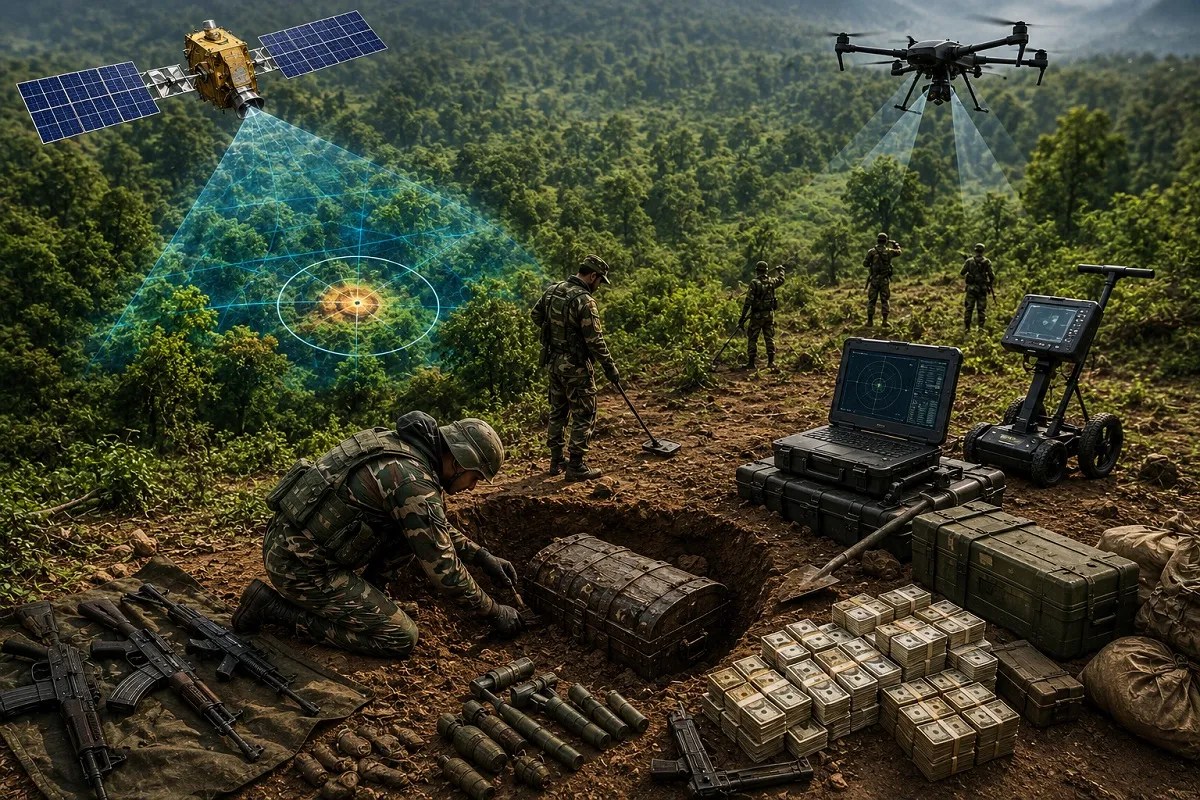
The operation leverages some of India’s most advanced defence and aerospace technologies, integrating ISRO satellite imagery, ground-penetrating radar, and specialised bomb disposal squad equipment. Over the last three months alone, targeted sweeps have already led to the seizure of sophisticated weaponry and cash valued at over ₹8 crore.
High-Tech Intelligence: ISRO’s ‘Eyes’ and Bomb Disposal ‘Hands’
To penetrate the dense forest canopy, security forces are utilising ISRO’s RISAT-2B satellite. The radar-imaging satellite identifies potential insurgent supply dumps by detecting subtle ground anomalies, such as:
Suspicious earth excavations and newly cleared trails.
Variations in ground temperature (thermal signatures).
These satellite insights are supplemented by low-altitude drone sorties equipped with thermal-scanning technology, mapping anomalies for ground teams to investigate.
Deconstructing the Naxalite “Dump Policy”
Investigation into the group’s logistics reveals a systematic “dump policy,” where insurgents historically buried roughly 50% of their extorted cash (levy) and weapons caches underground. To protect these assets, they developed a meticulous three-tier security system:
The Surface Layer: Covered with mud and camouflaged with thorny acacia branches.
The Defensive Layer: Rigged with Improvised Explosive Devices (IEDs) to deter intruders.
The Core Layer: Waterproofed plastic containers housing cash, ammunition, and weapons at the very bottom.
The precise coordinates of these dumps were heavily guarded, recorded only in complex code words known exclusively to top-tier commanders. However, a major breakthrough occurred following the recent surrender of a high-ranking leader. Data decrypted from his mobile phone has already exposed 22 secret dump locations. Historically, these buried funds were accessed twice a year to purchase fresh rations, cartridges, and advanced weaponry.
The Ongoing Challenge for Security Forces
While the Naxalite network in Bastar has been significantly hollowed out, the hundreds of underground caches still scatter the region with hidden hazards. Intelligence agencies warn that if left unrecovered, these resources could easily fund future recruitment drives or facilitate sudden retaliatory strikes.
Sundarraj P., Inspector General of the Bastar Range, emphasized that the security strategy has fundamentally evolved:
“The operation will continue until the very last detonator and underground explosive is neutralized. Our focus is no longer just on clearing active insurgents from the area, but on permanently dismantling their financial and logistical infrastructure. This is a decisive blow against what we consider ‘buried Naxalism’ within these forests.”
A Lingering Threat
Though major insurgent factions have been driven out of Bastar, the estimated ₹200 crore worth of weapons, explosives, and cash remaining beneath the soil keeps the region on high alert. Until these assets are completely excavated, they remain a potent tool for enticing vulnerable local youth back into the insurgency.